
The Importance of Balancing a Pool’s pH
pH is one of the most important and most misunderstood aspects of pool water chemistry. It controls water comfort, the strength of chlorine, the stability of alkalinity, and the long-term health of plaster, tile, equipment, and heaters. Keeping pH controlled is essential for both sanitation and surface protection.
What pH Actually Is
pH is a scale from 0 to 14 that measures how acidic or basic water is. Pool water normally operates between 7.2 and 7.8, which is slightly basic. Small changes in pH represent large changes in water chemistry because the pH scale is logarithmic, meaning each whole number represents a tenfold change in acidity.
How pH Relates to Total Alkalinity
Total Alkalinity (TA) is a measure of the water’s buffering capacity—its ability to resist swings in pH. When alkalinity is too low, pH becomes unstable and tends to crash. When alkalinity is too high, pH drifts upward consistently and becomes difficult to control.
The relationship is simple:
- pH is the value you directly control from day to day.
- Alkalinity controls how easily that pH moves.
Both must be maintained together for a stable, predictable system.
Why pH Matters for Surfaces and Chlorine Strength
pH affects everything in the pool:
- Low pH is corrosive and can dissolve plaster, etch grout, and damage heaters.
- High pH reduces chlorine efficiency dramatically. At a pH near 8.0, only a small portion of chlorine is active enough to sanitize effectively.
- High pH also encourages calcium to precipitate, contributing to scale on tile, heaters, and salt cells.
The ideal pH range for most pools is 7.2 to 7.6—strong enough for sanitation but gentle on surfaces and equipment. Industry groups such as the National Plasterers Council (NPC) base their surface care guidelines on keeping water near this balanced zone.
What Happens When pH Is Too Low
When pH drops much below 7.2, the water becomes increasingly aggressive:
- Plaster and grout can slowly dissolve, leading to etching, roughness, and color loss.
- Metal components such as ladders, handrails, heaters, and copper heat exchangers can corrode.
- Corroded metals can stain plaster and tile, often as brown, green, or black discoloration.
- Swimmers may experience burning eyes and irritated skin even when chlorine is in range.
Chronically low pH is one of the fastest ways to damage a new plaster surface or shorten the life of heaters and other metal components.
What Happens When pH Is Too High
When pH climbs much above 7.8, different problems show up:
- Chlorine becomes far less effective, increasing the risk of cloudy water and algae even when free chlorine levels appear adequate.
- Calcium is more likely to precipitate, leading to scale on tile lines, inside heaters, and on salt cells.
- Fine plaster dust and precipitated calcium can make the water appear dull or cloudy.
- Swimmers may notice dry, itchy skin and “red eye” irritation from chloramines building up in poorly sanitized water.
High pH by itself does not usually damage plaster immediately, but unchecked high pH combined with high alkalinity and calcium hardness can rapidly push water into a scale-forming condition.
The Role of LSI
The Langelier Saturation Index (LSI) is a combined measure of pH, alkalinity, calcium hardness, temperature, and TDS. It predicts whether water is likely to dissolve calcium from a surface or deposit it as scale. pH and alkalinity are major components of LSI, so they must be managed to keep LSI within a non-aggressive, non-scaling zone (reference: saturationindex.net).
pH and Alkalinity Interaction Curves
If you plot pH on one axis and total alkalinity on the other, you can visualize bands where water is corrosive, balanced, or scale-forming. For a given calcium hardness and temperature, each pair of pH and alkalinity values corresponds to an LSI value. Moving along a curve on that chart keeps LSI roughly constant, while crossing curves moves water into more aggressive or more scaling conditions.
At low alkalinity, small additions of acid or aeration can cause large swings in pH. At very high alkalinity, pH tends to drift upward and requires significant acid just to hold it steady. The goal is to keep pH and alkalinity in a region where the interaction curves show a neutral or slightly positive LSI, which usually means moderate alkalinity and pH centered near 7.4.
In practice, this means not looking at pH or alkalinity in isolation. A pH of 7.8 with very low alkalinity may still be aggressive, while a pH of 7.4 with very high alkalinity can still be scale-forming. The interaction curves are simply a visual way to see that behavior.
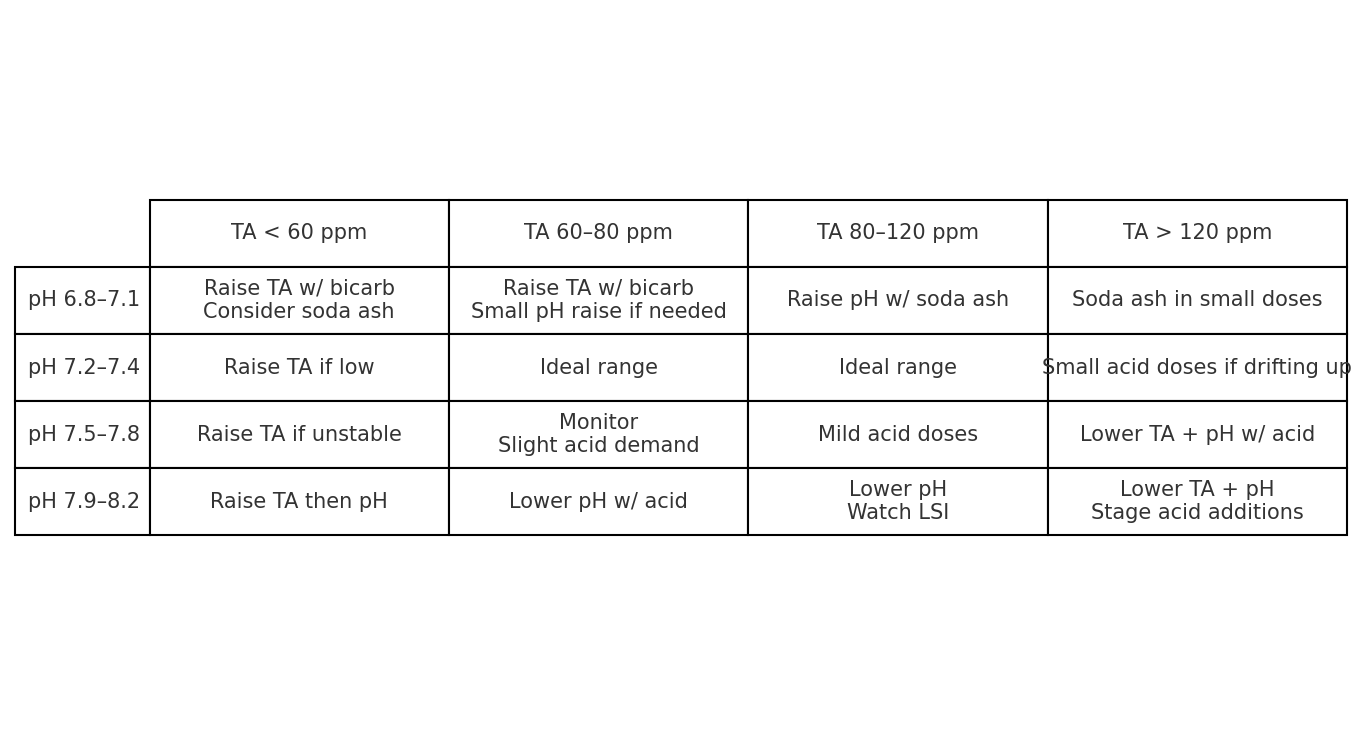
Quick pH and Alkalinity Dosing Reference
This chart summarizes common pH and alkalinity combinations and the typical correction. It is a guide, not a substitute for testing and calculating exact doses.
Understanding Muriatic Acid, Bicarbonate, and Soda Ash
Muriatic Acid (Hydrochloric Acid)
Muriatic acid is used to lower both pH and alkalinity. It is the most common acid used in pool service. When added, it reduces excess alkalinity, stabilizes pH drift, and makes chlorine more effective.
Sodium Bicarbonate (Bicarb)
Sodium bicarbonate is used to raise alkalinity with minimal effect on pH. When alkalinity is too low, even small amounts of acid or bather load can destabilize pH. Bicarb increases alkalinity and provides a buffering foundation.
Soda Ash (Sodium Carbonate)
Soda ash is used to raise pH with a small but noticeable increase in alkalinity. It is used when pH is too low, but alkalinity is within a reasonable range.
The Standard Four-Step Dosing Method
For any adjustment—acid, bicarbonate, or soda ash—the math follows the same pattern:
- Measure the current value (pH or alkalinity).
- Choose a realistic target value.
- Calculate the difference between target and current (the change in ppm or pH units).
- Use the dose per 10,000 gallons from your chart, then scale that dose to your actual pool volume.
Once you know how many “dose units” you need, the rest is just multiplication.
How to Perform Acid Dosing Calculations
Dosing calculations for muriatic acid depend on the amount of pH change needed, the pool volume, and the current alkalinity. A common standardized value is:
26 fluid ounces of muriatic acid lowers alkalinity by 10 ppm in 10,000 gallons.
Example: Lowering Alkalinity
Goal: Reduce alkalinity by 20 ppm in a 12,000 gallon pool.
- Current alkalinity is 120 ppm. The target is 100 ppm. The change needed is 20 ppm.
- Each dose unit (10 ppm) requires 26 fl oz per 10,000 gallons. 20 ppm divided by 10 ppm per unit equals 2 dose units.
- Two dose units at 26 fl oz each is 52 fl oz for 10,000 gallons.
- The pool is 12,000 gallons, so multiply 52 by 1.2 (12,000 ÷ 10,000) to get 62.4 fl oz.
The approximate dose is about 62 fl oz of muriatic acid. Acid should be added with the pump running, distributed in the deep end, and the water brushed to promote mixing. For large corrections, splitting the dose into two or more additions with retesting in between is safer and more controlled.
How to Perform Bicarbonate Calculations
When alkalinity is too low, bicarb is added. A common guideline is:
1.4 pounds of sodium bicarbonate raises alkalinity by 10 ppm in 10,000 gallons.
Example: Raising Alkalinity
Goal: Raise alkalinity from 50 ppm to 80 ppm in a 20,000 gallon pool.
- The change needed is 30 ppm (80 minus 50).
- Each 10 ppm increase is one dose unit. 30 divided by 10 equals 3 dose units.
- Each dose unit requires 1.4 pounds per 10,000 gallons. Three units is 1.4 × 3 = 4.2 pounds per 10,000 gallons.
- The pool is 20,000 gallons, so multiply 4.2 by 2 (20,000 ÷ 10,000) to get 8.4 pounds.
The approximate dose is 8.4 pounds of bicarbonate. Bicarb dissolves best when broadcast across the surface with the pump running. As with acid, large corrections are often split into multiple additions with retesting between doses.
How to Perform Soda Ash Calculations
Soda ash is used when pH is too low and you need a stronger correction than bicarb provides. Soda ash typically raises pH aggressively and raises alkalinity moderately.
A common dose factor is:
6 ounces of soda ash raises pH by roughly 0.2 to 0.3 units in 10,000 gallons, depending on alkalinity.
Example: Raising pH
Goal: Raise pH from 7.0 to 7.4 in a 15,000 gallon pool.
- The change needed is 0.4 pH units.
- Using 0.2 units per 6 oz, 0.4 units is two dose units.
- Two dose units at 6 oz each is 12 oz per 10,000 gallons.
- The pool is 15,000 gallons, so multiply 12 by 1.5 (15,000 ÷ 10,000) to get 18 oz.
The approximate dose is around 18 ounces of soda ash. It should be added slowly to avoid clouding or localized scale formation. For sensitive plaster or very soft water, two smaller additions with retesting in between are safer.
When to Choose Acid vs. Bicarb vs. Soda Ash
- Add acid when pH is high and alkalinity is high or drifting upward.
- Add bicarbonate when alkalinity is too low but pH is near normal or only slightly low.
- Add soda ash when pH is low and alkalinity is acceptable or only slightly low.
The Big Picture
pH balance is not a one-time task. It is a continuous back-and-forth between acid demand, bather load, aeration, alkalinity, and chlorine strength. Once you understand how pH behaves and how it responds to adjustments, keeping a pool balanced becomes predictable and straightforward. When pH and alkalinity are managed together, LSI stays in a safe band, surfaces last longer, and chlorine works the way it is supposed to.