
Cyanuric Acid (CYA) & Conditioner
Cyanuric acid (CYA), commonly called stabilizer or conditioner, is one of the most misunderstood components of pool chemistry. At the right level, it protects chlorine from rapid destruction by sunlight. At high levels, it slows chlorine’s disinfecting power, suppresses ORP, increases chlorine demand, and can complicate nearly every aspect of pool maintenance. This page explains how CYA actually works chemically, why it is essential in outdoor pools, and how to calculate dosing with confidence.
What Cyanuric Acid Actually Is
CYA is a heterocyclic organic acid—specifically, 1,3,5-triazine-2,4,6-trione. It forms a six-membered ring that can exist in different tautomeric forms depending on pH. These forms include:
- H3CYA (fully protonated)
- H2CYA−
- HCYA2−
- CYA3− (fully deprotonated)
These species exist in a shifting equilibrium based on pH. In a typical pool (pH 7.2–7.8), the dominant forms are H2CYA− and HCYA2−. Because these equilibria are slow, CYA acts both as a weak acid and as a complexing agent for chlorine.
CYA-Chlorine Binding Chemistry
When chlorine dissolves in water, it forms hypochlorous acid (HOCl), the strong disinfecting species, and hypochlorite ion (OCl−), which is far weaker. In water containing CYA, a new equilibrium forms:
HOCl + CYA ⇌ Chlorinated Cyanurate
CYA can bind 1, 2, or 3 chlorine atoms. These bound forms (mono-, di-, and trichloro-cyanurate) hold chlorine much more tightly than the HOCl/OCl− system alone. The equilibrium is reversible, but the presence of CYA shifts most chlorine out of the “active” HOCl form and into these bound reservoir states.
Why this matters
- The free chlorine (FC) test will still read normal, because it measures both HOCl and its cyanurate-bound forms.
- But HOCl—the truly disinfecting form—may be only a few tenths of a percent of total FC at high CYA levels.
- This slows kill rates and increases required CT values dramatically.
Sunlight Protection and UV Decay
Without CYA, ultraviolet light destroys chlorine very quickly. Studies show:
- Within 1 hour of sunlight, a pool with 0 CYA can lose 75–90% of its chlorine.
- At 10 ppm CYA, chlorine loss drops dramatically.
- At 30–40 ppm CYA, UV protection reaches a plateau—adding more stabilizer offers diminishing returns.
This is why outdoor pools must use some stabilizer. But above ~40 ppm, UV protection barely improves, while disinfection slows dramatically.
How CYA Suppresses HOCl
The Lonza paper you provided shows HOCl fraction plummets as CYA rises:
- 0 ppm CYA → 47% HOCl
- 5 ppm CYA → 13% HOCl
- 10 ppm CYA → 7% HOCl
- 20 ppm CYA → 3% HOCl
- 50 ppm CYA → 1% HOCl
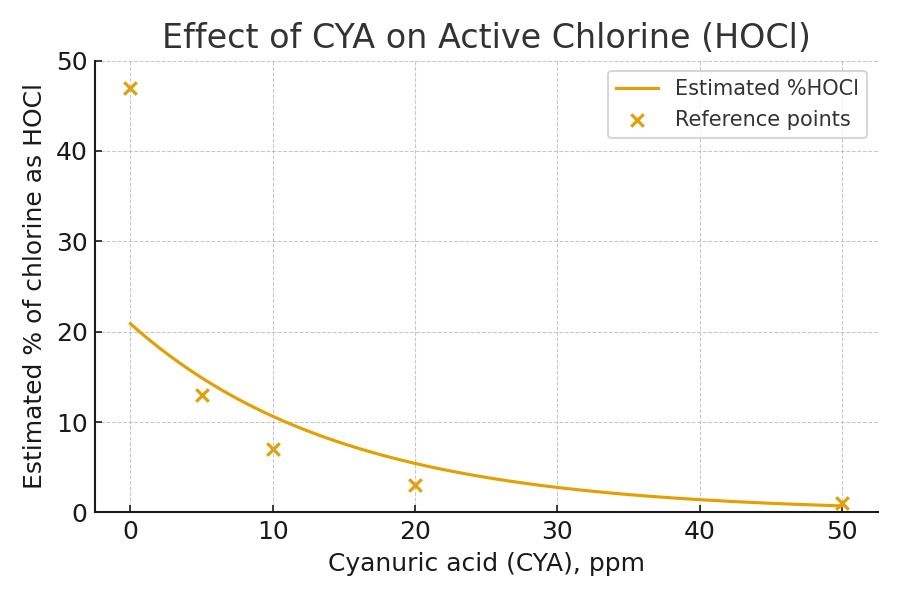
These numbers are not arbitrary—they directly determine chlorine kill speed. The less HOCl you have, the slower pathogens are destroyed and the more chlorine is needed to achieve equivalent sanitation.
ORP Suppression: Why CYA “Hides” Chlorine
ORP (oxidation-reduction potential) measures the real-time oxidizing strength of the water. High CYA levels cause ORP to collapse even when FC is high because:
- HOCl contributes strongly to ORP.
- Bound chlorine does not.
- Therefore, as CYA rises, HOCl falls → ORP falls → oxidation slows.
In commercial or regulated pools, ORP may fail to meet the minimum disinfecting threshold even when FC looks “fine” on a test strip.
Why Low CYA Is Also a Problem
Below 10 ppm CYA in an outdoor pool:
- Chlorine is strong chemically but unprotected.
- UV destroys chlorine faster than most feeders can supply it.
- Daily FC swings between 0 and 10+ ppm can occur, increasing corrosion, odor, and bather irritation.
Understanding the 14:1 CYA:FAC Ratio
At about a 14:1 ratio of CYA to free chlorine, the HOCl concentration matches that of monochloramine—a slow, weak disinfectant. Above this ratio, chlorine behaves increasingly like chloramine rather than HOCl.
Examples:
- 1 ppm FC → keep CYA under 14 ppm
- 3 ppm FC → CYA under ~42 ppm
- 5 ppm FC → CYA under ~70 ppm
This ratio is essential because it tells you not just the “right” CYA level, but the minimum chlorine needed for that stabilizer level to be effective.
CDC Crypto Response and CYA Limits
The CDC requires CYA < 15 ppm for hyperchlorination after a diarrheal fecal incident. Above ~15 ppm CYA, experimental data show that even extremely high chlorine levels cannot achieve a required 3-log reduction in Cryptosporidium. :contentReference[oaicite:0]{index=0}
Stabilized Chlorines: Dichlor and Trichlor
Dichlor (Sodium Dichloro-s-triazinetrione)
Dissolves quickly, adds both CYA and chlorine, slightly lowers pH. Contains ~56–62% available chlorine, ~50% CYA by weight.
Trichlor (Trichloroisocyanuric Acid)
Slow-dissolving tablet; very acidic (pH ~2.8); ~90% available chlorine; adds large amounts of CYA.
How stabilized chlorine adds CYA over time
- Every 10 ppm of FC added by dichlor adds roughly 9 ppm CYA.
- Every 10 ppm of FC added by trichlor adds roughly 6 ppm CYA.
A pool using only stabilized chlorine will see CYA creep steadily upward unless water is replaced regularly.
CYA Accumulation Over Time
Example for a 15,000 gallon pool using trichlor tablets exclusively:
- Daily FC demand: 2 ppm
- Trichlor adds ~0.6 ppm CYA for each 1 ppm FC delivered
- CYA gain per day: 2 × 0.6 = 1.2 ppm
- Monthly gain: ~36 ppm per month
This is why many pools end the season with 100–200 ppm CYA unless water replacement or unstabilized chlorine is used.
CYA Solubility and Dissolution Behavior
Pure granular CYA dissolves slowly because:
- CYA becomes less soluble as pH drops.
- It dissolves fastest in warm, high-pH water with circulation.
- Adding it directly to the skimmer can cause filter “caking.”
The recommended technique is using a skimmer sock or dissolving CYA in a bucket before adding it to the pool.
How to Dose CYA: Full Formula and Example
CYA dosing is based on a simple mass balance, scaled to pool volume.
Exact Formula (pounds)
Dose (lb) = 8.34 × Δppm × (pool gallons ÷ 1,000,000)
Simplified Field Formula (ounces)
13 oz (weight) raises CYA by 10 ppm in 10,000 gallons
Dose (oz) = 13 × (Δppm ÷ 10) × (pool gallons ÷ 10,000)
Example: Raising CYA from 5 ppm to 30 ppm in 20,000 gallons
- Δppm = 30 − 5 = 25 ppm
- 25 ÷ 10 = 2.5 units of “10 ppm”
- Pool volume factor = 20,000 ÷ 10,000 = 2
- Dose = 13 × 2.5 × 2 = 65 oz
You would add about 65 oz (just over 4 pounds) of granular stabilizer.
Testing CYA: Limitations and Sources of Error
The standard turbidity (cloudiness) test for CYA is notoriously imprecise. Key issues include:
- Lighting conditions greatly affect readings.
- Viewing tube geometry changes perceived cloudiness.
- CYA must be fully dissolved and mixed—often 24–48 hours—before retesting.
- Test kits tend to underestimate at high CYA levels (>80 ppm).
For more accurate readings, laboratory methods use spectrophotometry instead of turbidity. For field use, consistency in technique matters more than the specific kit.
Reducing Excessive CYA
CYA cannot be chemically removed. Only dilution reduces it. The dilution formula is:
New CYA = Current CYA × (Remaining water %)
Example: Reducing CYA from 150 ppm to 50 ppm
50 ÷ 150 = 0.333 → keep 33% of the water
Therefore: drain 67% of the pool and refill.
Long-Term Strategy for Managing CYA
- Use stabilized chlorine only when needed (startup, rain dilution, low-CYA scenarios).
- Switch to liquid chlorine or cal-hypo once CYA reaches the desired range.
- Keep the CYA:FAC ratio under 14:1 to maintain good HOCl levels.
- Plan seasonal partial drain/refill if using trichlor as primary chlorine source.
Summary
CYA is essential for outdoor pools but dangerous when misunderstood. At proper levels, it stabilizes chlorine, reduces chemical cost, and keeps sanitation predictable. At excessive levels, it slows disinfection, suppresses ORP, complicates breakpoint chlorination, and forces higher chlorine usage. Understanding CYA’s chemistry, equilibria, and dosing allows you to keep the pool stable, efficient, and safe all season long.